





In Partnership with the Centre for Ocular Research & Education, CORE Knowledge 3.0 to Debut in the Academy’s Exhibit Floor Booth
WATERLOO, ONTARIO, October 11, 2022—Many of the world’s preeminent ocular researchers, educators, clinicians, and executives will travel to San Diego later this month, taking part in the American Academy of Optometry’s centennial celebration and annual meeting. As part of the festivities, the Academy has partnered with the Centre for Ocular Research & Education (CORE) to host CORE Knowledge 3.0—the latest iteration of the world’s ultimate eye science game.
Available for game play within the Academy exhibit booth #537 during show hours, the immersive digital experience presents players with a range of rapid-fire, multiple choice questions covering a wide variety of basic and clinical ocular research topics. Points are added and deducted as participants race a two-minute clock, tapping their screens to correctly answer as many questions as possible before time runs out.
In addition to new and revised content developed by CORE, the Academy has provided a supplemental set of questions specific to the storied history of the association. Members of the International Association of Contact Lens Educators (IACLE) have also supplied new questions designed to challenge even the most confident participants.
“We are delighted to collaborate with Academy on this initiative—a fun and fitting way to look back on so many of its accomplishments over the past 100 years,” said Lyndon Jones, PhD, FCOptom, FAAO, FBCLA, director of CORE. “When CORE Knowledge 1.0 debuted at ARVO, it drew non-stop crowds, with players collectively answering nearly 15,000 questions over more than 1,100 games. With its completely refreshed design and upwards of 750 questions, we anticipate healthy competition in San Diego to become the champion.”
During the annual meeting, daily winners will receive prizes supplied by the Academy, as will the top three scorers overall during its three-day run. Live leaderboards will be prominently displayed in the Academy booth, helping fuel the competitive spirit of conference attendees from around the world.
Following the Academy annual meeting, the game will be made available for online play on laptops and mobile devices. Customized versions of CORE Knowledge are also available for license by manufacturers, educational institutions and ocular associations.
# # #
About the Centre for Ocular Research & Education (CORE)
The Centre for Ocular Research & Education (CORE) was established in 1988 at the University of Waterloo’s School of Optometry & Vision Science. Over the next three decades, the organization evolved from a three-person operation into a thriving hub of basic and applied research, collaborating with sponsors, agencies and academia on advanced biosciences, clinical research and education. Its uncompromising independence and results of the highest quality have been at the heart of many of the most prominent advances in eye health. Today, its approximately 50-person team serves a range of ophthalmic sectors, including medical devices, ocular pharmaceuticals, digital technology and others, with a focus on the anterior segment. For more information, please visit core.uwaterloo.ca.
About the American Academy of Optometry Centennial Celebration
During this year’s annual meeting, the Academy will present a “Centennial Celebration” in recognition of its past 100 years. Highlights include “Let’s Dance and Deal”, on Friday, October 28, beginning at 9 p.m. This celebratory party is an opportunity for attendees to mingle with friends, dance through the decades, and enjoy casino games. Other events include the unveiling of an exhibit honoring the legacy and leadership of past and current Fellows and a dynamic 64-foot-long timeline and video sharing the Academy’s growth and evolution through the years. All events will be at the San Diego Convention Center.
MEDIA CONTACTS:
Aimee J. Lewis or Mike McDougall, APR, Fellow PRSA, McDougall Communications for CORE
aimee@mcdougallpr.com +1.585.414.9838 | mike@mcdougallpr.com +1.585.545.1815
 Mark Bullimore, renowned scientist and adjunct professor at the University of Houston, provides the
  The
The  James Loughman, professor of Optometry and Vision Science at Technological University Dublin and director of the Centre for Eye Research Ireland,
  Kate and Paul Gifford, prominent clinical scientists and co-founders of Myopia Profile, share a valuable
 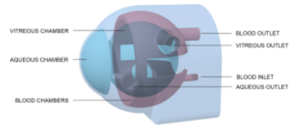 The resulting “eye” included aqueous, vitreous, and blood chambers, a blood outlet/inlet, aqueous and vitreous outlets, and a 500μm-thick cornea—absent any artificial support structures. Phosphate-buffered saline was used as an aqueous and vitreous humor mimic in the corresponding drug delivery study, which measured contact lens-delivered dye transfer in each chamber and channel.
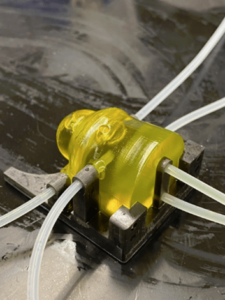 large-scale projects, and extremely expensive. This severely limits its use for high-throughput applications in many academic and research settings,” said Chau-Minh Phan, research assistant professor at CORE. “Our work shows the promise of an alternative approach, with much faster layer-based printing at a significantly lower cost. We believe this is a starting point for developing enhanced 3D eye models to test drug release kinetics of various devices and formulations.”







 “Rosa’s work on improving the clinical efficacy of specialty lenses through optimized design and auxiliary technologies—especially for myopia control and visual rehabilitation—is a natural fit with CORE’s growing work in these sectors,” said Dr. Lyndon Jones, CORE’s director.
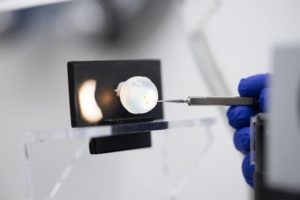 OcuBall feels like a human eye and simulates a realistic response to embedded foreign bodies, similar to those found in clinical environments. It replaces animal-based methods in optometry training environments while eliminating safety concerns related to handling, disposal and storage of biological tissue.
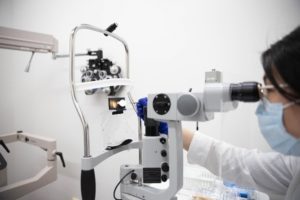 OcuBall comes premade with metal steel particles inserted on the surface of the eye to provide a realistic, safe and inexpensive clinical scenario for the practice of foreign body removal. Over time, the metal pieces can rust and form a typical rust ring, just as they do in the human eye. Use in educational settings helps optometry students practice and gain confidence in the removal of materials from the eye.