





CORE’s Latest Contact Lens Compendium Features US Products
WATERLOO, Ontario, July 14, 2020 For the first time, the premier searchable contact lens database for eye care practitioners (ECPs)—the Contact Lens Compendium—is available for United States practitioners. With the launch of US Compendium, ECPs now have free access to the most up-to-date listing of contact lens products, including the latest parameters on lenses, solutions and rewetting drops currently available in the US market.
Maintained by the Centre for Ocular Research & Education (CORE) at the University of Waterloo, this vital resource is updated regularly online and offers a variety of search options for product filtering and comparison, enabling practitioners to easily find suitable products for their patients. Manufacturers are also able to log in to update product information directly. The project is a resource of Contact Lens Update and the US version may be accessed at https://compendium.contactlensupdate.com/us.
With a few keystrokes, ECPs can quickly find and compare contact lenses across the entire universe of available products. For instance, a fitter can pull up silicone hydrogel daily disposable lens options for a patient with a -8.00D prescription in seconds, or easily query all monthly hydrogels for a hyperopic astigmat of +4.00/-2.25 x 35. The advanced search function enables exact parameters to be used, saving time and presenting perhaps otherwise overlooked possibilities.
Compendium has long been available for the Canadian market in both print and online formats. The online version has become a valuable resource for thousands of Canadian optometrists.
“As we’ve seen online usage of Compendium grow in Canada, we’ve heard from practitioners that it is their go-to resource for contact lens product information,” says Sarah Guthrie, Senior Research Scientist at CORE. “We wanted to bring that same comprehensive online reference for lenses and solutions to optometrists in the US.”
A print version will be updated annually and is available for either free download or bound hard copy purchase at https://compendium.contactlensupdate.com/us/print_version.
The Contact Lens Compendium versions exist with the financial support of both the optometric profession and the contact lens industry.
# # #
About the Centre for Ocular Research & Education (CORE)
The Centre for Ocular Research & Education (CORE) – formerly known as the Centre for Contact Lens Research – was established in 1988 at the University of Waterloo’s School of Optometry & Vision Science. Over the next three decades, the organization evolved from a three-person operation into a thriving hub of basic and applied research, collaborating with sponsors, agencies and academia on advanced biosciences, clinical research and education. Its uncompromising independence and results of the highest quality have been at the heart of many of the most prominent advances in eye health. Today, its approximately 50-person team serves a range of ophthalmic sectors, including medical devices, ocular pharmaceuticals, digital technology and others, with a focus on the anterior segment. For more information, please visit core.uwaterloo.ca.
MEDIA CONTACTS:
Aimee J. Lewis or Mike McDougall, APR, Fellow PRSA
McDougall Communications for CORE
aimee@mcdougallpr.com +1.585.414.9838 | mike@mcdougallpr.com +1.585.434.2150
 AdHawk has incorporated the OcuBlink eyeballs into its round-the-clock robotic testing system to evaluate its algorithms and new devices, such as AR/VR glasses, with a high degree of replicability. This precision is required for the company’s unique microsystems that take and process thousands of measurements every second, allowing on-the-fly velocity calculations with unprecedented resolution. Since velocity profiles of saccades (the rapid involuntary movements of the eye) are highly consistent, AdHawk’s proprietary algorithms can predict where a user will look.

 WATERLOO, Ontario, May 20, 2020—“

 A recent literature review from Professor Emeritus Desmond Fonn and the
 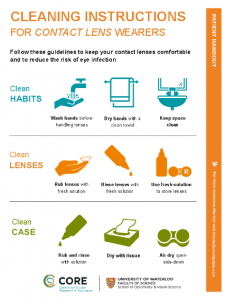 The paper notes that in line with its ability to reduce the spread of disease, careful and thorough hand washing with soap and water followed by hand drying with unused paper towels should greatly reduce the transfer of microbial contamination from hands to the contact lens or eye. Clean hands plus use of daily disposables results in the lowest risk of contact lens-related complications. For wearers of reusable lenses there are additional guidelines on lens and case cleaning which can be
 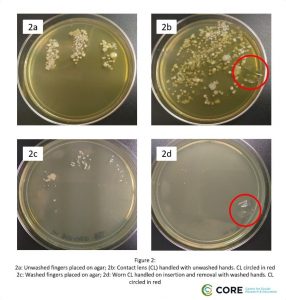 hands. Unwashed hands were pressed into agar (Figure 2a), and also used to handle a new contact lens (Figure 2b). Scientists then repeated the procedure after following recommended handwashing practices, touching both the agar directly, along with applying and removing a contact lens (Figures 2c and 2d). The results clearly demonstrate the impact handling has on contact lenses. Samples that had been touched with unwashed hands showed significantly higher numbers of visible bacteria. By comparison, the contact lens touched with clean hands had only a minimal bacterial load.